Too Much Power in a Pencil Skirt: Why Reclaiming Pin-Up Makes Certain People Deeply Uncomfortable
There's a particular kind of discomfort that surfaces whenever a woman announces, loudly and without apology, that she finds vintage pin-up culture genuinely empowering. You can almost set your watch by the responses. From one direction comes the pearl-clutching traditionalist crowd, uneasy with the overt sensuality. From the other comes a faction of feminist critics who insist that corsets and bullet bras are, by definition, tools of oppression — relics of a male gaze that no amount of reclamation can neutralize.
Both camps are certain they're protecting women. Neither seems especially interested in asking the women themselves.
That tension — and the revealing discomfort underneath it — is exactly what makes the modern pin-up revival so worth paying attention to.
The Original Contradiction
Pin-up culture has always carried a paradox at its core. The Golden Age images — think Alberto Vargas's impossibly leggy illustrations, the breezy Technicolor photographs of Betty Grable, the knowing smirk of Bettie Page — were produced largely by and for a male audience. The women in those images were styled, lit, directed, and distributed by industries run almost entirely by men. On the surface, that's a straightforward story of objectification.
Except it wasn't quite that simple, even then.
Many of the women who built careers in mid-century pin-up photography negotiated their own contracts, developed their own personas, and leveraged their images into genuine financial independence at a time when female economic autonomy was barely a concept. Bettie Page didn't stumble into iconhood — she cultivated it with intention, building a brand before anyone used that word. The "passive object" narrative falls apart pretty quickly when you actually look at the biographical record.
So from the very beginning, pin-up existed in a space where exploitation and agency were tangled together in ways that resist easy categorization. The women who are drawn to this aesthetic today are inheriting that complexity, not erasing it.
The Feminist Fault Line
Here's where things get genuinely interesting. Modern feminist discourse around pin-up tends to split along a fairly predictable line. On one side, scholars and critics influenced by second-wave thought argue that aesthetics shaped by the male gaze cannot be authentically reclaimed — that choosing to embody them, no matter how consciously, simply reproduces the original power structure with extra steps. The corset, in this reading, is always a cage, regardless of who's lacing it up.
On the other side, a growing body of feminist cultural criticism — and a whole lot of actual women doing actual pin-up shoots — pushes back hard. Their argument: the problem was never the aesthetic. The problem was the absence of choice. When a woman is told she must perform femininity in a particular way for someone else's gratification, that's coercion. When she deliberately selects that same femininity from a full menu of options, constructs it herself, and presents it on her own platform on her own schedule, something categorically different is happening.
The clothing didn't change. The power dynamic did.
What's striking is that both positions claim to center women's liberation, yet one of them requires dismissing what a significant number of women actually report feeling. There's something worth examining in a feminism that trusts women to make complex decisions about careers, finances, and healthcare, but not about what to wear or how to present their bodies.
Who Actually Gets Nervous — And Why
Pull back a little further and a pattern emerges. The fiercest gatekeeping around pin-up culture tends to come from people — across the political spectrum — who share one underlying assumption: that female sexuality is inherently dangerous unless it's properly managed.
Conservatives have historically wanted that management to look like modesty and domesticity. Certain strains of progressive thought want it to look like a rejection of "male-defined" beauty standards. The specific prescription differs. The presumption that someone else needs to be doing the prescribing stays remarkably consistent.
A woman who reclaims pin-up aesthetics on her own terms disrupts both frameworks simultaneously. She's not modest, so she troubles the traditionalist. She's not rejecting conventional femininity, so she troubles the purist. She's enjoying herself, which troubles everyone who built their worldview on the idea that this particular kind of enjoyment requires rescue.
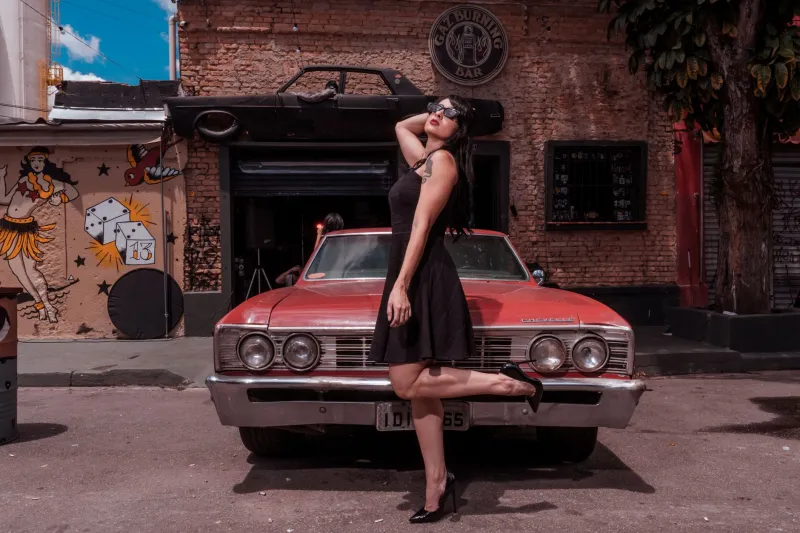
That's a lot of disrupted frameworks for one woman in a wiggle dress.
The Community That Built Itself
What often gets lost in the theoretical debate is the lived reality of contemporary pin-up culture in America. Spend any time in the community — at vintage-themed events, in the comment sections of pin-up photography pages, in the forums where enthusiasts swap sourcing tips for reproduction crinoline — and you encounter something the critics rarely account for: genuine collective joy.
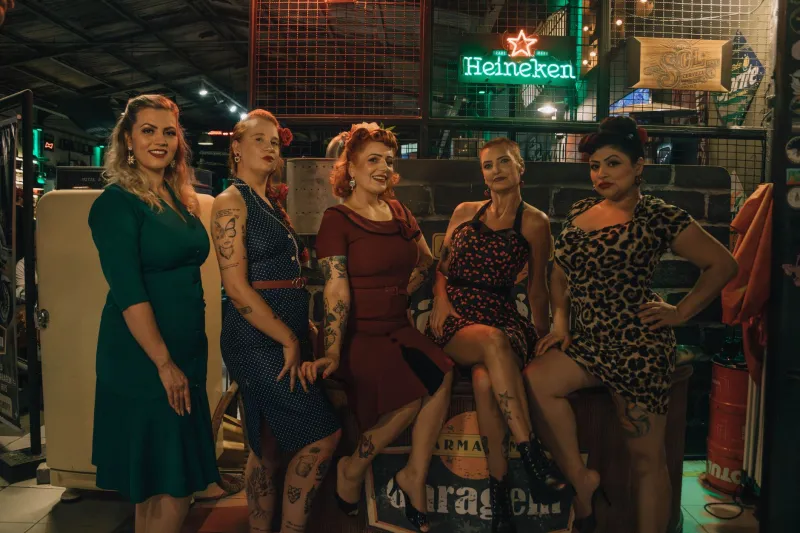
This is a scene built substantially by women, for women. The photographers, makeup artists, wardrobe stylists, event organizers, and community leaders skew heavily female. The conversations happening inside pin-up culture about body image are, frankly, more nuanced and inclusive than those in plenty of spaces that loudly brand themselves as feminist. Women of every size, age, race, and background participate and find the aesthetic works for them — not despite the retro trappings, but often because the exaggerated, theatrical quality of vintage pin-up creates a kind of costume freedom that feels less fraught than navigating contemporary beauty standards.
It's harder to feel like you're failing to measure up to an ideal when the ideal is explicitly a 1950s illustration.
Authenticity Is the Real Threat
Here's the thing about authenticity: it's genuinely threatening to gatekeepers of all varieties, because it can't be managed from the outside. A woman who has thought carefully about why she loves vintage aesthetics, who understands the history, who has made a deliberate and joyful choice — she doesn't need anyone's permission or validation. That self-sufficiency is, in many ways, the most radical thing about the modern pin-up revival.
The tension around this aesthetic isn't really about hemlines or bullet bras or whether it's okay to enjoy looking like a Vargas illustration. It's about the persistent cultural discomfort with women who know exactly what they want and don't particularly care whether that choice fits anyone else's liberation narrative.
The paradox of pin-up is that an aesthetic born partly from objectification has become, for many women, a vehicle for the precise opposite. That's not a contradiction to be resolved. It's a complexity to be respected — and if it makes certain gatekeepers deeply uncomfortable, that discomfort is probably telling us something important about whose agency we've actually been willing to protect all along.