Fake It Till You Mean It: How Pin-Up's Glorious Artifice Became the Most Honest Thing Online
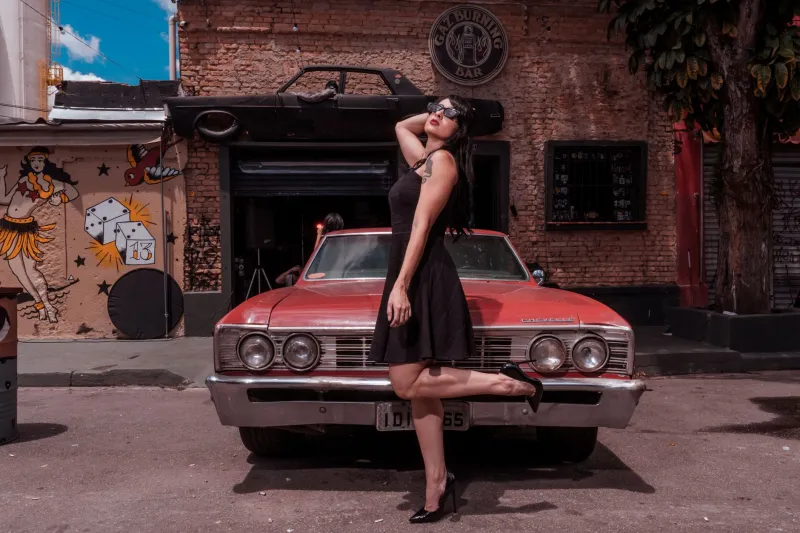
Here's a weird thing to sit with: we live in the age of the no-filter selfie, the 'authentic moment,' the deliberately messy kitchen background on a Zoom call. Audiences have declared war on anything that looks too polished, too posed, too constructed. And yet — vintage pin-up imagery is having one of its biggest cultural moments in decades. Women are booking retro-style shoots, building pin-up followings in the hundreds of thousands, and spending serious money on bullet bras and victory rolls. So what gives?
The answer, it turns out, isn't a contradiction at all. It's actually kind of brilliant.
The Authenticity Industrial Complex
Let's talk about what 'authenticity' actually looks like online in 2024. It looks like a celebrity posting a makeup-free selfie — that took forty-five minutes to light correctly. It looks like an influencer's 'candid' kitchen moment, shot by a professional photographer who was paid to make it look accidental. It looks like brands using the word 'real' in ad copy while running those ads through six rounds of agency approval.
The performance of not performing has become its own highly managed aesthetic. And audiences — smart, media-literate American audiences especially — are starting to clock it. There's something exhausting about being sold 'realness' that has clearly been stress-tested in a focus group.
Pin-up never pretended to be anything other than what it was. The whole enterprise was theatrical from the jump. The lighting was deliberate. The poses were choreographed. The hair took hours. The smile was practiced in a mirror. And nobody hid any of that — it was the point.
The Honest Lie
There's a concept in theater called the 'honest lie' — the idea that a performance openly declared as fiction can communicate more truth than a documentary that claims objectivity. Pin-up operates on exactly that principle.
When you look at a classic Elvgren painting or a George Hurrell photograph, there's an implicit contract. You know this is constructed. The model knew it was constructed. The artist definitely knew it. Nobody is pretending otherwise. And inside that shared understanding, something genuinely expressive happens. The woman in the frame gets to be whoever she wants to be. The viewer gets to appreciate the craft, the beauty, the humor, the wit — without the creeping suspicion that they're being manipulated into thinking it's spontaneous.
Compare that to a modern Instagram post carefully engineered to look like a candid moment, and suddenly the pin-up feels like the more straightforward transaction. It's not trying to sneak anything past you.
Why Constructed Doesn't Mean Fake
One of the most persistent misconceptions about vintage pin-up culture is that the artifice erased the women involved — that the styling and posing and retouching turned real people into mannequins. But spend any time with the actual history and you find the opposite.
Betty Page wasn't performing a character that had nothing to do with her. She was amplifying parts of herself — the playfulness, the confidence, the willingness to inhabit her own body without apology — through the grammar of a highly stylized form. The construction was the vehicle, not the cage.
Modern pin-up practitioners talk about this constantly. The ritual of getting into the look — the corset, the seams, the red lip — isn't about hiding who you are. It's about deciding, deliberately and intentionally, how you want to show up. That's not inauthenticity. That's agency.
The Retro Shoot as Radical Act
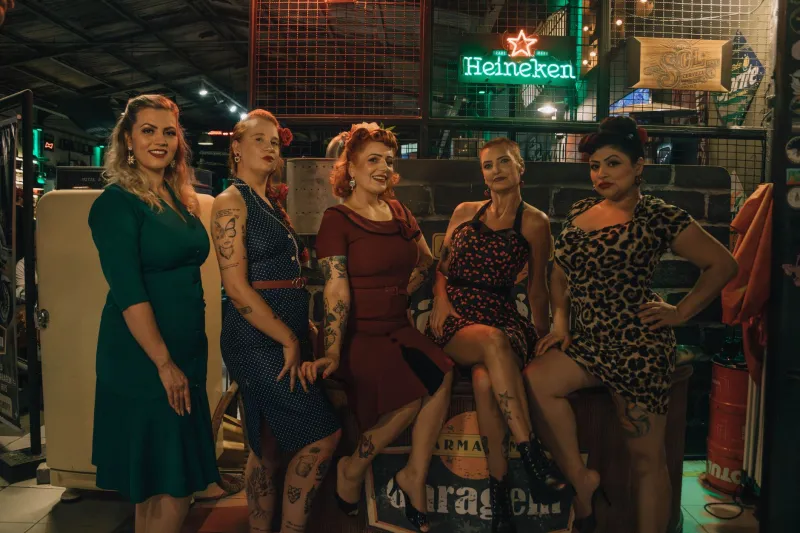
Book a pin-up photography session in any major American city right now and you'll find waitlists. The clientele isn't just vintage enthusiasts — it's women of every background, age, and body type who want an experience that's the complete opposite of the curated-casual aesthetic dominating their feeds.
What they're paying for, when you strip it back, is permission to be entirely, unashamedly on purpose. To occupy space in a frame without pretending it's an accident. To be gorgeous and know it and have that be fine.
In a cultural moment where women are simultaneously pressured to look effortlessly beautiful and perform low-maintenance nonchalance about the whole thing, pin-up's explicit glamour is almost punk. It refuses the double bind entirely.
The Algorithm Hates Stillness
There's also a practical dimension to why vintage glamour resonates right now. Digital platforms are relentlessly optimized for volume, velocity, and 'relatable' content. The aesthetic they reward is fast, disposable, and designed to not feel designed.
Pin-up exists outside that logic almost entirely. A great pin-up image is meant to be looked at — really looked at — not scrolled past in 0.3 seconds. The composition rewards attention. The styling rewards knowledge. The humor, when it's there, rewards a second glance.
In that sense, engaging with vintage pin-up culture is a small act of resistance against the attention economy. You're choosing to slow down and appreciate something that took craft and intention to create. That's not nostalgia — that's a preference for depth over throughput.
Artifice as Self-Respect
Maybe the most interesting angle on all of this is what pin-up's deliberate construction says about self-regard. There's an argument — and it's a compelling one — that taking the time to craft your presentation is a form of respect: for yourself, for the people who'll see you, for the occasion.
The Golden Age bombshell who spent three hours getting ready wasn't being vain. She was communicating that she took the moment seriously. That she brought her full self to it. That she wasn't going to phone it in with a messy bun and a 'this is just how I am' shrug.
In an era that fetishizes low effort as a virtue, that's a genuinely countercultural stance.
The Paradox Resolves Itself
So here's where we land: vintage pin-up thrives in the age of authenticity precisely because it never claimed to be authentic in the modern sense. It claimed to be crafted, considered, and intentional — and it delivered on that promise completely.
In a media landscape full of performed spontaneity and manufactured rawness, something that's openly, joyfully, unapologetically constructed stands out as the most honest thing in the room.
That's not a paradox anymore. That's just good sense.