Why We Can't Look Away: The Hidden Psychology Behind Pin-Up's Eternal Pull
There's a reason you can hang a vintage Vargas print in a room and watch every single person's eyes drift toward it within seconds. It isn't just nostalgia. It isn't just the aesthetic. Something deeper is happening — something that operates below the level of conscious thought and taps directly into the wiring of human attraction, fantasy, and emotional longing.
Vintage pin-up imagery has been doing this for decades, and the more you understand why, the more impressive the whole thing becomes.
The Brain on Beauty: It's More Complicated Than You Think
Psychologists who study visual attraction will tell you that the human brain processes images in layers. The first layer is immediate and instinctive — shapes, colors, contrast. The second layer is contextual — what's the story here, what does this mean? The third layer is emotional — how does this make me feel?
Classic pin-up art was engineered, whether intentionally or not, to work all three of those layers simultaneously. The bold reds and warm skin tones hit the instinctive layer fast. The playful scenario — a gust of wind, a ladder, a strategically placed prop — kicks in the contextual layer. And then the emotional payoff arrives: a feeling of warmth, humor, desire, and something that functions almost like intimacy with a total stranger.
That's not an accident. The artists and photographers behind the golden age of pin-up were incredibly skilled at manufacturing emotional experiences through composition alone.
Red Isn't Just a Color — It's a Signal
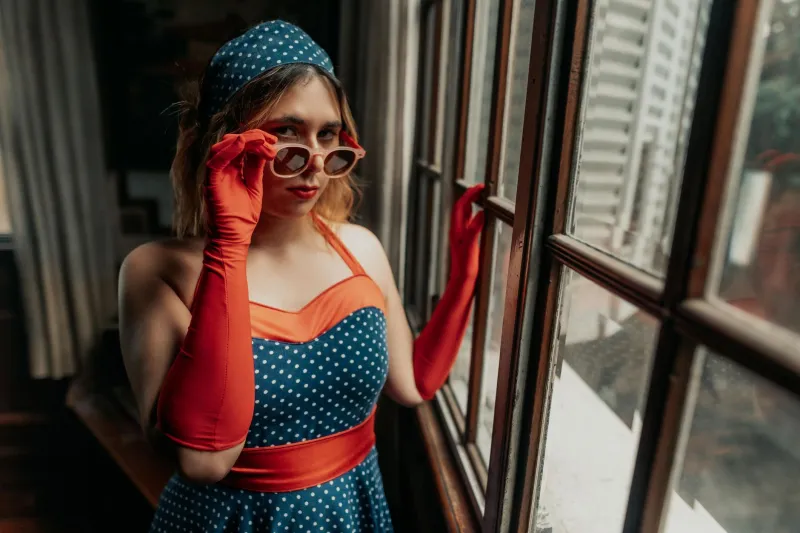
Color psychology is one of the most underappreciated tools in the vintage pin-up toolkit. Red lips, red nails, red swimsuits, red heels — the recurring presence of red in classic pin-up imagery isn't a stylistic quirk. It's a deeply embedded psychological cue.
Research consistently shows that red signals vitality, confidence, and availability across cultures. It raises the heart rate slightly. It draws the eye faster than almost any other color in the spectrum. When a 1950s pin-up artist painted a woman in a fire-engine red one-piece against a pale blue background, they were essentially hacking the viewer's visual system.
But here's the nuance that separates great pin-up art from the merely pretty: those same images almost always balanced the red with softer, more approachable tones. Warm peach skin, golden hair, pastel backgrounds. The red created excitement; the softness created safety. Together, they produced something genuinely irresistible — arousal without threat, desire without danger.
The Power of the Almost
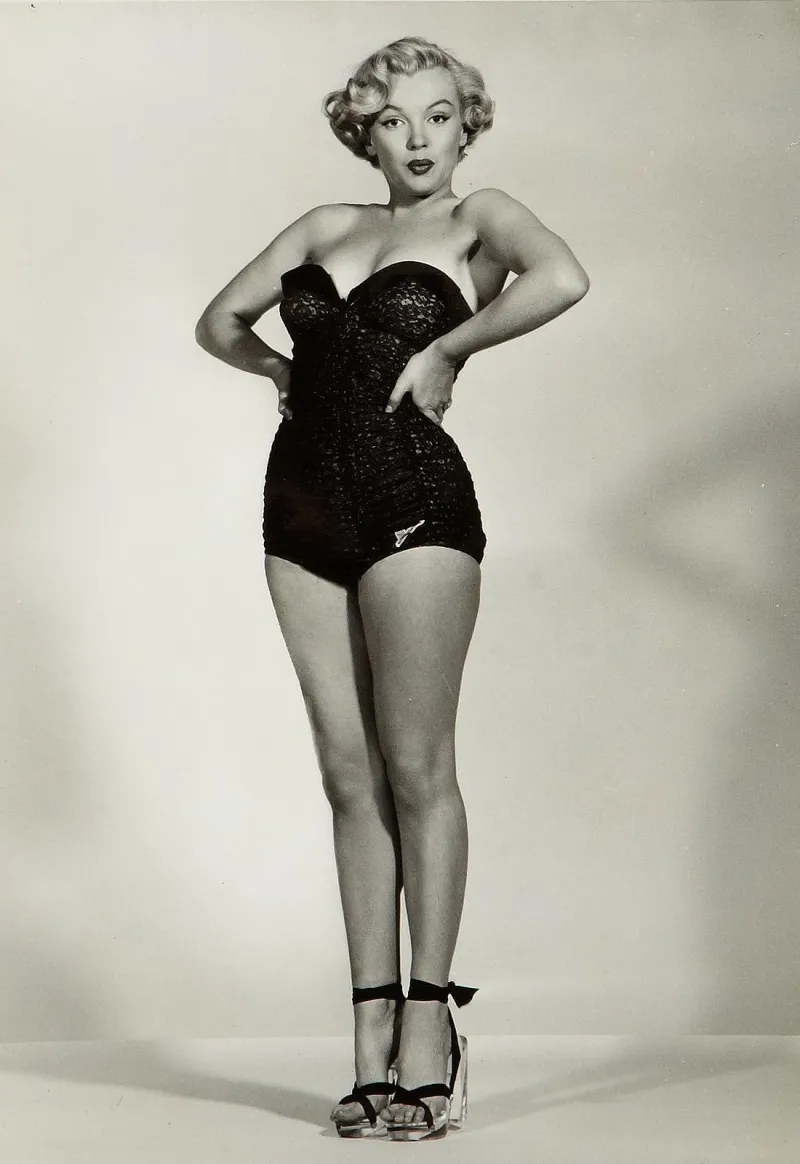
One of the most psychologically sophisticated elements of vintage pin-up is what it doesn't show. The hem that's just a little too high. The strap that's slipped just a little too far. The glance over the shoulder that suggests the subject is aware of being watched — and is perfectly okay with it.
This is the principle of suggestion at work, and its psychological roots run deep. Human imagination, when given a partial picture, will always complete the scene in the most personally compelling way possible. That's not a bug in our cognitive software; it's a feature. We are meaning-making creatures, and when presented with an incomplete image, we fill in the gaps with our own desires.
Explicit imagery skips this step entirely. It presents a finished picture that leaves nothing to the imagination. Classic pin-up, by contrast, hands you the first few chapters of a story and trusts you to write the rest yourself. The result is that every viewer, in some sense, creates a slightly personalized version of the image in their own mind. That's a level of engagement that's incredibly hard to manufacture any other way.
Confidence as the Ultimate Aphrodisiac
If you strip away the styling, the color palettes, and the compositional tricks, the single most consistent psychological driver in vintage pin-up imagery is confidence.
The women in these images — whether photographed or painted — almost universally project a sense of absolute comfort in their own skin. They aren't performing vulnerability. They aren't seeking approval. They're inviting you into their world on their own terms, with a smile that says they already know how this is going to go.
From a psychological standpoint, this is enormously compelling. Confidence signals competence, self-awareness, and agency. It creates what researchers call an "approach motivation" — we move toward confident people because, on some primal level, we associate confidence with resources, vitality, and positive social outcomes.
In the context of desire, confidence functions as a multiplier. It takes physical attractiveness and turns it into something more complex and more magnetic — a full personality projected through posture, expression, and gaze.
The Nostalgia Effect: Why Vintage Hits Different
There's another psychological layer at work for modern audiences specifically, and it has everything to do with nostalgia. Psychologists describe nostalgia as a "bittersweet" emotion — it combines warmth and longing in a way that's actually quite pleasurable. When we engage with vintage imagery, we're not just responding to the content; we're responding to the idea of that era.
For many Americans, the 1940s and 1950s carry a particular cultural mythology — a time of clarity, optimism, and a certain uncomplicated glamour. Never mind that the reality was considerably more complicated. The feeling of that era, as transmitted through pin-up imagery, is one of warmth and confidence and fun. And that feeling is genuinely comforting, especially in a media landscape that often feels saturated with anxiety and complexity.
Vintage pin-up gives people a permission slip to inhabit a simpler emotional space for a moment. That's not escapism in a negative sense — it's a legitimate psychological need, and it's one that these images have been meeting for generations.
Visual Storytelling and the Fantasy of the Everyday
One of the most underrated aspects of classic pin-up composition is how relentlessly ordinary the settings are. A woman washing her car. A secretary reaching for a top-shelf file. A girl caught in an unexpected rainstorm. These aren't exotic scenarios — they're Tuesday afternoon situations that have been elevated into something electric.
Psychologically, this grounds the fantasy in the accessible. The message isn't "this woman exists in a world you can never reach." The message is "this could happen anywhere, to anyone, at any moment." That accessibility is a crucial ingredient in sustained desire. Fantasy that feels completely unattainable tends to collapse under its own weight. Fantasy that feels just within reach? That's the kind that sticks around.
Still Running the Game After All These Years
What's remarkable about all of this is how well it holds up. The psychological principles that made a 1947 calendar girl captivating are the same ones that make a modern pin-up shoot go viral on social media today. The platforms have changed. The styling has evolved. But the human brain hasn't been updated.
We still respond to red. We still fill in the gaps with our imaginations. We still find confidence magnetic and accessibility comforting. We still crave the warmth of nostalgia and the pleasure of a story that invites us in without spelling everything out.
Vintage pin-up didn't just capture a moment in American cultural history. It cracked a code. And as long as humans are humans, that code is going to keep working.