Tassels, Then and Now: How Burlesque Went From Smoky Clubs to the Main Stage
Picture a dimly lit club somewhere in Manhattan, circa 1942. A live orchestra is mid-swing, cigarette smoke curls toward the ceiling, and a woman in enough rhinestones to blind a front-row audience is working the stage like she owns the city. The crowd is rapt. This is burlesque at its golden-age peak — theatrical, teasing, and absolutely electric.
Now fast-forward to a sold-out show at a renovated theater in Brooklyn, or a DIY performance space in Austin, or a drag-friendly venue in Los Angeles. The rhinestones are still there. So is the electricity. But the performers on stage today are doing something the original headliners never quite could: they're writing their own rules.
Burlesque has always been a shape-shifter. Understanding where it's been helps explain why its current revival feels so alive — and why it matters beyond just the spectacle.
The Original Bombshells: Burlesque in Its Heyday
The golden age of American burlesque — roughly the 1930s through the 1950s — was a product of its contradictions. The country was simultaneously puritanical and desperate for escape. Economic hardship, wartime anxiety, and strict social codes all existed alongside a roaring appetite for entertainment that pushed limits. Burlesque fit right into that gap.
The form itself predates that era considerably — it evolved from 19th-century theatrical traditions that mixed comedy, parody, and risqué performance — but it reached its commercial and cultural peak in the mid-20th century. Venues like Minsky's in New York and the Old Howard in Boston were household names, drawing audiences who came as much for the comedy and spectacle as for the striptease.
The women who defined that era weren't just performers — they were full-blown stars. Gypsy Rose Lee turned intellectual wit into a performance style, writing, lecturing, and cultivating a persona that was as much about brains as body. Sally Rand made an art form out of fan dancing, creating illusion through movement and feathers rather than explicit reveal. Ann Corio built a decades-long career on a combination of genuine comedic talent and expert audience management. These women understood something fundamental: the tease was always more powerful than the show.
What audiences loved then was the event of it — the live orchestra, the elaborate costuming, the comedic sketches between numbers, the sense of shared transgression in a room full of strangers. Burlesque was communal in a way that felt genuinely special.
The Lean Years and the Comeback
By the 1960s, burlesque was in trouble. The rise of explicit film, changing social norms, and competition from new entertainment formats eroded its audience. Many classic venues closed. The form didn't disappear entirely — it mutated into strip club culture, which retained the surface elements while losing most of the theatrical craft — but the golden-age version largely faded from mainstream view.
The revival began quietly in the 1990s, driven by performers who were drawn to burlesque's theatrical roots and its complicated relationship with female agency. By the early 2000s, neo-burlesque had become a genuine movement, with troupes, festivals, and dedicated venues popping up across the country. The Exotic World Burlesque Museum (now the Burlesque Hall of Fame) in Las Vegas became a pilgrimage site and a living connection to the original era.
What made this revival stick wasn't just nostalgia — it was the way contemporary performers interrogated and expanded the form.
What Modern Performers Are Actually Doing
Today's burlesque scene is genuinely diverse in ways its predecessor wasn't. Performers of all body types, gender identities, and backgrounds are working in the form, and many of them are explicit about using burlesque as a vehicle for feminist and political expression. That's a significant departure from the mid-century version, where the performers were talented and often savvy, but the industry itself was largely controlled by men.
The contemporary approach tends to honor vintage aesthetics — the costuming, the musicality, the slow-burn reveal — while centering the performer's own narrative. A modern burlesque act might be a tribute to a specific golden-age star, a satirical commentary on beauty standards, a celebration of a particular cultural identity, or simply an exercise in theatrical glamour for its own sake. The range is enormous.
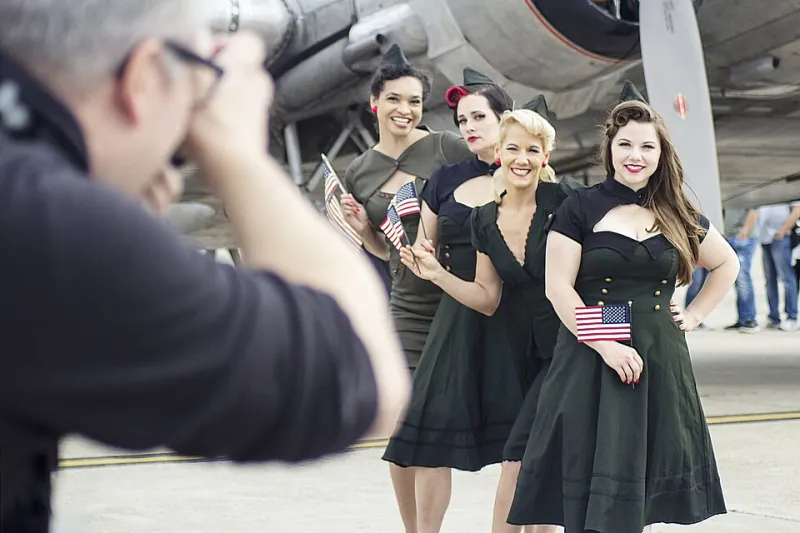
Costume and styling remain central to the art form, and this is where the vintage pin-up connection runs deepest. Many neo-burlesque performers are meticulous students of mid-century fashion — the construction of a proper bullet bra, the architecture of a gown designed to be dramatically removed, the precise curl pattern of a victory roll. Getting those details right is a form of respect for the tradition, even when the performance itself is doing something entirely new.
The Digital Stage: Democratizing Access
One of the most significant shifts in contemporary burlesque is how digital platforms have changed who gets to participate — both as performers and as audience members. During the pandemic, many performers moved their acts online, discovering that streaming and recorded content could reach audiences who'd never have access to a live show in a major city.
That democratization has continued. Burlesque performers build communities on social media, sell tickets to virtual shows, and connect with fans and fellow artists across the country without needing a physical venue. For performers in smaller markets, or those whose acts don't fit neatly into local scenes, online platforms have been genuinely transformative.
It's worth noting that this creates an interesting tension with what made golden-age burlesque so special — that live, communal, slightly illicit energy of being in a room together. The best modern performers navigate this by treating online content as a supplement to live performance rather than a replacement, using digital platforms to build an audience that then shows up in person.
Then vs. Now: What's Really Different
Some things haven't changed at all. The craft of the slow reveal, the importance of musicality, the power of a performer who genuinely commands a room — these are as essential now as they were when Gypsy Rose Lee was holding court at Minsky's.
What's different is the conversation around it. Modern burlesque is self-aware in a way its predecessor couldn't afford to be. Today's performers are actively engaging with questions about who the art form is for, who it empowers, and what it says about beauty, desire, and performance. That critical dimension gives contemporary burlesque an intellectual texture that, ironically, would have appealed to someone like Gypsy Rose Lee, who spent her whole career insisting that burlesque was smarter than people gave it credit for.
Audiences have changed too. The mid-century crowd was largely male and there for specific reasons. Today's burlesque audiences skew younger, more gender-diverse, and often more interested in the theatrical and artistic elements than in anything explicitly titillating. Many shows have a festival atmosphere — celebratory, communal, and genuinely joyful.
Why It Still Matters
Burlesque has survived for as long as it has because it taps into something persistent in human nature: the pleasure of spectacle, the power of suggestion, and the particular thrill of watching someone perform total confidence in their own skin. Those things don't go out of style.
At Pin-Up 365, we see burlesque as one of the living roots of vintage glamour culture — a direct line from the golden age to the present, carried forward by performers who understand that honoring tradition doesn't mean freezing it in amber. The tassels spin, the music swells, and the art form keeps reinventing itself. Just like it always has.