Bombshells, Brushstrokes & Brave Hearts: How WWII Pin-Up Culture Built an American Icon
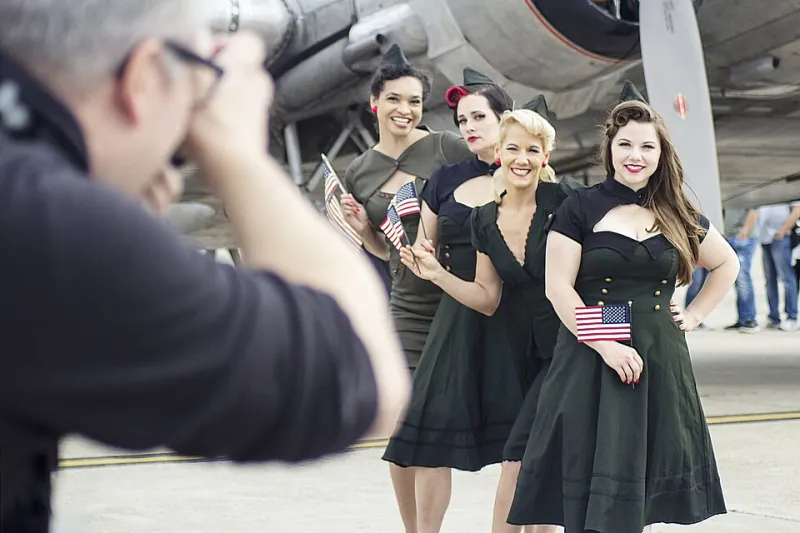
Photo: U.S. Army photo by Ashley Keasler, Public domain, via Wikimedia Commons
There's something almost electric about a classic 1940s pin-up image. The soft curl of a Victory roll, the knowing smile, the confident tilt of a hip — it communicates something that transcends its era. What most people don't realize is that this aesthetic wasn't born in a Hollywood studio or a glossy magazine. It was forged, quite literally, in wartime.
Welcome to Pin-Up 365, where we celebrate vintage glamour every single day of the year — and today, we're going deep on the roots of it all.
From Barracks Walls to Cultural Bedrock
When the United States entered World War II following Pearl Harbor in December 1941, millions of young American men found themselves shipped overseas, far from home and facing circumstances no one wanted to think too hard about. Military brass quickly recognized that morale was as critical as ammunition. Enter the pin-up.
Photographs and illustrated images of beautiful women — wholesome yet undeniably alluring — were distributed through magazines like Yank, The Army Weekly and Stars and Stripes. Soldiers taped them inside footlockers, painted them on bomber nose cones, and folded them into letters home. These weren't just pretty pictures. They were emotional anchors — a reminder of what normal life looked like, and what was worth fighting for.
The term "pin-up" itself came from the literal act of pinning these images to walls. Simple enough. But what happened next was anything but simple.
The Photographers Who Changed Everything
A handful of photographers and illustrators during this period essentially invented the visual grammar of American glamour. Their work set standards that still feel fresh eight decades later.
Alberto Vargas is perhaps the most celebrated name in the genre. The Peruvian-born illustrator joined Esquire magazine in 1940 and began producing his "Varga Girls" — airbrushed, luminous figures rendered in impossible pastels. His women weren't passive. They laughed, stretched, lounged with total confidence. Vargas understood that the most compelling pin-up wasn't just beautiful — she was alive.
On the photography side, Bernard of Hollywood (Bruno Bernard) brought a cinematic quality to his studio work, shooting stars like Marilyn Monroe and Ava Gardner with a warmth that felt personal rather than staged. His images blurred the line between celebrity portrait and pin-up fantasy in a way that felt genuinely new.
Then there was Earl Moran, whose painted pin-ups for Brown & Bigelow calendars hung in garages and diners across the country. Moran actually used a young Norma Jeane Baker — before the world knew her as Marilyn Monroe — as a model for some of his earliest work. History, hiding in plain sight.
The Models Who Made History
Behind every legendary image was a woman who chose to show up, pose, and own it — often at a time when that took real nerve.
Betty Grable became arguably the most famous pin-up of the entire war era. Her famous over-the-shoulder pose, shot in 1943, was reproduced millions of times and became synonymous with American femininity for a generation. What made Grable special wasn't just her looks — it was her accessibility. She felt like someone's girl next door, just considerably more glamorous.
Rita Hayworth brought a smoldering sophistication that contrasted beautifully with Grable's all-American sweetness. Her 1941 Life magazine photo, kneeling on a bed in a lace negligee, became one of the most widely reproduced images of the decade. An image so iconic it literally went to war — a copy was reportedly attached to the atomic bomb dropped on Bikini Atoll in 1946.
These women weren't passive subjects. Many were active participants in the USO, performing overseas, writing to soldiers, and understanding deeply that their image carried real emotional weight for real people in real danger.
The Aesthetic That Refused to Fade
So what is it about 1940s pin-up imagery that keeps pulling us back?
Part of it is the craft. Pre-digital photography demanded that every element — lighting, posing, wardrobe, expression — be considered and deliberate. There was no fixing it in post. The result was imagery with a tactile, human quality that digital perfection sometimes struggles to replicate.
Part of it is also the attitude. The pin-up aesthetic celebrated curves at a time when fashion often didn't. It was confident without being aggressive, sensual without being explicit. It found a sweet spot that still resonates — and that contemporary photographers, fashion designers, and beauty brands keep returning to.
You can see 1940s pin-up DNA in everything from Dita Von Teese's entire career to the resurgence of high-waisted silhouettes on fashion runways. MAC Cosmetics built entire collections around the red lip and cat-eye combo that Grable and Hayworth made famous. Photographers like David LaChapelle and Ellen von Unwerth have both cited the era as a touchstone.
Even in mainstream advertising, the warm color palettes, the knowing smiles, and the emphasis on confident feminine presence trace directly back to those calendar paintings and magazine spreads from 75 years ago.
Why It Matters Now
At Pin-Up 365, we think about this history constantly — because understanding where an aesthetic comes from makes it richer, not just for nostalgia's sake, but because it connects us to something real.
The women who posed for those wartime images were making a choice. They were saying: beauty matters, joy matters, the human desire to feel connected to something lovely matters — even in dark times. Especially in dark times.
That's a message that doesn't really age.
The Golden Age of American pin-up wasn't just a moment in popular culture. It was a movement that proved glamour could carry genuine emotional power. It built an aesthetic language that American culture has been fluent in ever since — one that shows up every time someone chooses a red lip for courage, or strikes a pose that says I know exactly who I am.
And honestly? We think that's worth celebrating 365 days a year.